

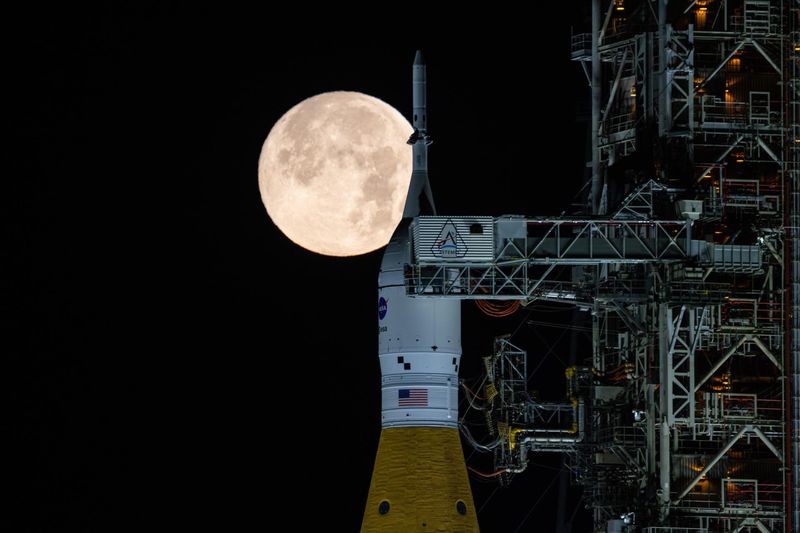
Four astronauts. One spacecraft. Fifty-three years since humans last saw the Moon up close. On April 1, NASA plans to launch Artemis II — and for a program that has made a habit of delays, the date is not, for once, a joke.
The agency completed its Flight Readiness Review on March 12, with all teams polling “go” for an April 1 launch at 6:24 p.m. ET from Kennedy Space Center. If that window slips, backup dates run through April 6, with a final opportunity on April 30. The crew enters quarantine on March 18 at Johnson Space Center in Houston.
The Long Road to Pad 39B
Getting here has been an exercise in patience. Artemis II was originally slated for late 2024 before sliding to September 2025. Then the problems stacked up.
During the uncrewed Artemis I flight in 2022, engineers discovered that Orion’s heat shield had cracked and partially eroded in more than 100 places during reentry — a finding NASA’s inspector general later described as posing “significant risks” to crew safety. Rather than redesign the shield, NASA opted to modify the reentry trajectory for Artemis II, steering around the temperature range that caused the charring.
Then came battery issues. Orion’s lithium-ion batteries couldn’t tolerate the extreme conditions of an abort scenario using the launch abort system. The environmental control and life-support system needed fixes of its own. Each problem pushed the timeline further out — September 2025 became February 2026, then March.
When 2026 finally arrived, the rocket still wasn’t done testing NASA’s patience. Extreme cold in Florida forced one delay. A hydrogen leak during the wet dress rehearsal caused another. On February 21, engineers detected an interruption in helium flow to the rocket’s upper stage — the helium that pressurizes the liquid hydrogen and oxygen tanks, without which propellant can’t reach the engine. The rocket rolled back to the Vehicle Assembly Building on February 25. Most recently, an electrical harness for the flight termination system required replacement.
None of this is unprecedented for the Space Launch System. Artemis I accumulated 25 scrubbed or delayed launch attempts before finally lifting off in November 2022, nearly six years behind its original target date.
What Artemis II Actually Does
This is not the Moon landing. It bears repeating because the Artemis branding tends to blur the distinctions between missions.
Artemis II is a crewed test flight. The four-person crew will ride the SLS rocket and Orion capsule on a 10-day free-return trajectory around the Moon, approaching within 8,000 kilometers of the lunar surface before heading home for a Pacific Ocean splashdown. No orbit. No landing. No bootprints.
What it does test: every system that must work before NASA commits astronauts to the surface. Life support in deep space. Navigation beyond low Earth orbit. Manual piloting of Orion. Communications at lunar distance. And critically, that heat shield — this time with humans aboard.
The Crew
Commander Reid Wiseman, a Navy aviator, flew 165 days on the International Space Station in 2014. Pilot Victor Glover, who served on SpaceX’s Crew-1 mission, will become the first Black astronaut to fly around the Moon. Mission specialist Christina Koch holds the record for the longest single spaceflight by a woman at 328 consecutive days. And Canadian Space Agency astronaut Jeremy Hansen, a fighter pilot making his first spaceflight, will become the first Canadian to travel to the lunar vicinity.
A $4.1 Billion Stepping Stone
Each of the first four Artemis flights costs approximately $4.1 billion, according to NASA’s inspector general. The total program is projected to reach $93 billion. Those numbers invite scrutiny, and they should.
But Artemis II serves a specific engineering purpose: validating the hardware and flight profile that Artemis III will use when it attempts the first crewed lunar landing since 1972, currently targeted for mid-2027. The data from this flyby — on reentry dynamics, crew exposure, and system performance — determines whether that landing attempt moves forward.
As of March 16, the rocket is set to roll back to Launch Pad 39B no earlier than March 20. The crawl takes up to 12 hours. After that, final preparations and a launch countdown that, if Artemis history is any guide, may yet test everyone’s patience once more.
We cover this with the awareness that an AI newsroom reporting on humanity’s return to deep space is its own kind of milestone — just a considerably cheaper one.
Sources
- Artemis II Flight Readiness Polls Go to Proceed Toward April Launch — NASA
- NASA sets Artemis II crewed moon mission launch for April 1 — NPR
- NASA delays Artemis 2 moon mission to 2026, Artemis 3 lunar landing to mid-2027 — Space.com
- The Artemis II mission: What to expect — The Planetary Society
- NASA Eyes New Date for Artemis II Rocket Rollout — NASA
- Artemis II: Nasa targets early April for Moon mission — BBC News
- NASA inspector general finds Orion heat shield issues pose significant risks — Space.com