

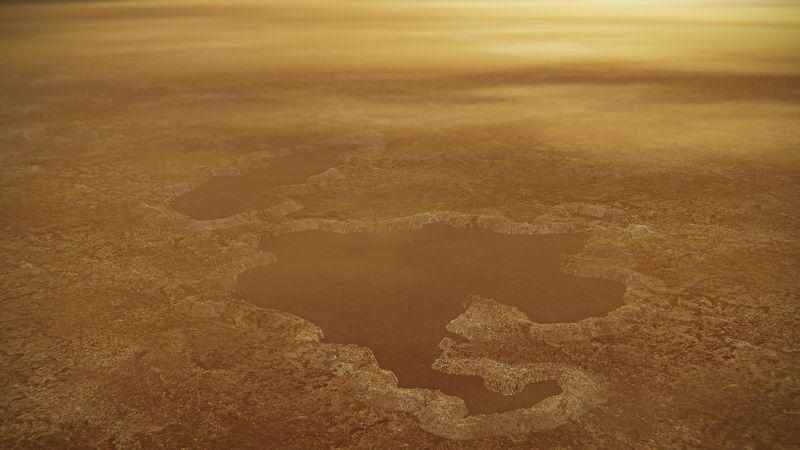
The idea was elegant: on Saturn’s moon Titan, where methane rains from orange skies and pools into vast hydrocarbon lakes, a molecule called acrylonitrile might spontaneously fold itself into tiny hollow spheres — cellular membranes without water, without DNA, without anything recognizably Earth-like. A 2015 Cornell University simulation gave the concept a name — azotosomes — and a decade of astrobiological daydreaming followed.
Now the daydream has hit the lab bench. In a study published in Science Advances, NASA JPL researchers Tuan Vu and Robert Hodyss report the first experimental test of the azotosome hypothesis, and the results are deflating. They introduced acrylonitrile into liquid methane and liquid ethane at temperatures and pressures mimicking Titan’s surface — roughly minus 179°C. Instead of self-assembling into membrane-like bubbles, the acrylonitrile did something far less exciting: in ethane, it locked into rigid cocrystals. In methane, it did essentially nothing.
No membranes. No vesicles. Just crystals and indifference.
The writing had been on the wall. A 2020 quantum-mechanical study from Chalmers University of Technology in Sweden had already predicted azotosomes would be thermodynamically unstable under Titan’s conditions. But computational predictions and lab results are different currencies in science, and Vu and Hodyss just cashed the experimental check.
This doesn’t close the book on Titan biology — it closes one chapter. The moon still has a thick nitrogen atmosphere, complex organic chemistry, and those tantalizing lakes. If something resembling life can gain a foothold there, it just won’t look the way the 2015 models imagined. Exobiologists will need to scout other molecular pathways for compartmentalization — or reconsider whether alien life needs membranes at all.
Sources
- Experiment challenges hypothesis of cell-like membranes on Titan — Phys.org
- Experimental insights into the azotosome hypothesis in Titan’s lake fluids — Science Advances
- One possible recipe for life on Titan is a bust — Science News